What to Do in a Medical Emergency in the Philippines: 911, Ambulances, ERs and the No-Deposit Rule
Quick Answer: Dial 911, the free national emergency hotline that has routed police, fire and medical calls through one number since September 2025, or Red Cross 143, then go to the nearest hospital with an emergency room. Under Republic Act 10932 no hospital may demand a deposit before emergency treatment, and PhilHealth now pays for ER care that does not end in admission. This guide covers the numbers, the ambulance options, the warning signs of stroke and heart attack, and poison control.
In a medical emergency in the Philippines, dial 911: since 11 September 2025 it has been the single national number for police, fire and medical help, free and open 24 hours (GMA News, September 2025). The Philippine Red Cross answers on 143. Then go to the nearest hospital with an emergency room, public or private: Republic Act 10932 makes it a crime to demand a deposit before emergency treatment, and PhilHealth now pays for emergency room care even when you are not admitted. This guide lists who to call, how ambulances work and what they cost, which ER to choose, the warning signs that cannot wait, and where to find the nearest hospital in the hospital directory.
Who do you call, and where do you go?
| Situation | Who to call | Where to go |
|---|---|---|
| Any life-threatening emergency: collapse, severe bleeding, difficulty breathing, road crash | 911 (free, 24/7); Red Cross 143 or +63 2 8790 2300 | Nearest hospital with an emergency room; the crew decides on transfer |
| Suspected stroke or heart attack | 911 for an ambulance; do not drive yourself | Nearest Level 2 or Level 3 hospital with an ICU; a Level 1 hospital will stabilise and transfer |
| Poisoning, overdose, snakebite | National Poison Management and Control Center, UP-PGH: +63 2 8524 1078 | Emergency room, with the product container |
| Animal bite | Local health office or 911 if bleeding is severe | Wound washing at once, then the nearest Animal Bite Treatment Center for anti-rabies vaccine |
| Labour or pregnancy emergency | 911 | Nearest hospital with a maternity ward; RA 10932 covers women in active labour |
| Disaster, flood, typhoon rescue | 911; NDRRMC (02) 8911-1406 | As directed by the local disaster office |
The official PH Emergency Hotlines portal lists 911, the Red Cross and the disaster agencies. Before the unified system, the DILG counted 35 local governments with their own hotlines and some 200 fire bureau numbers; they now route through 911 (Philstar, September 2025). Where a city still advertises a local number, it works too.
How do ambulances work, and what do they cost?
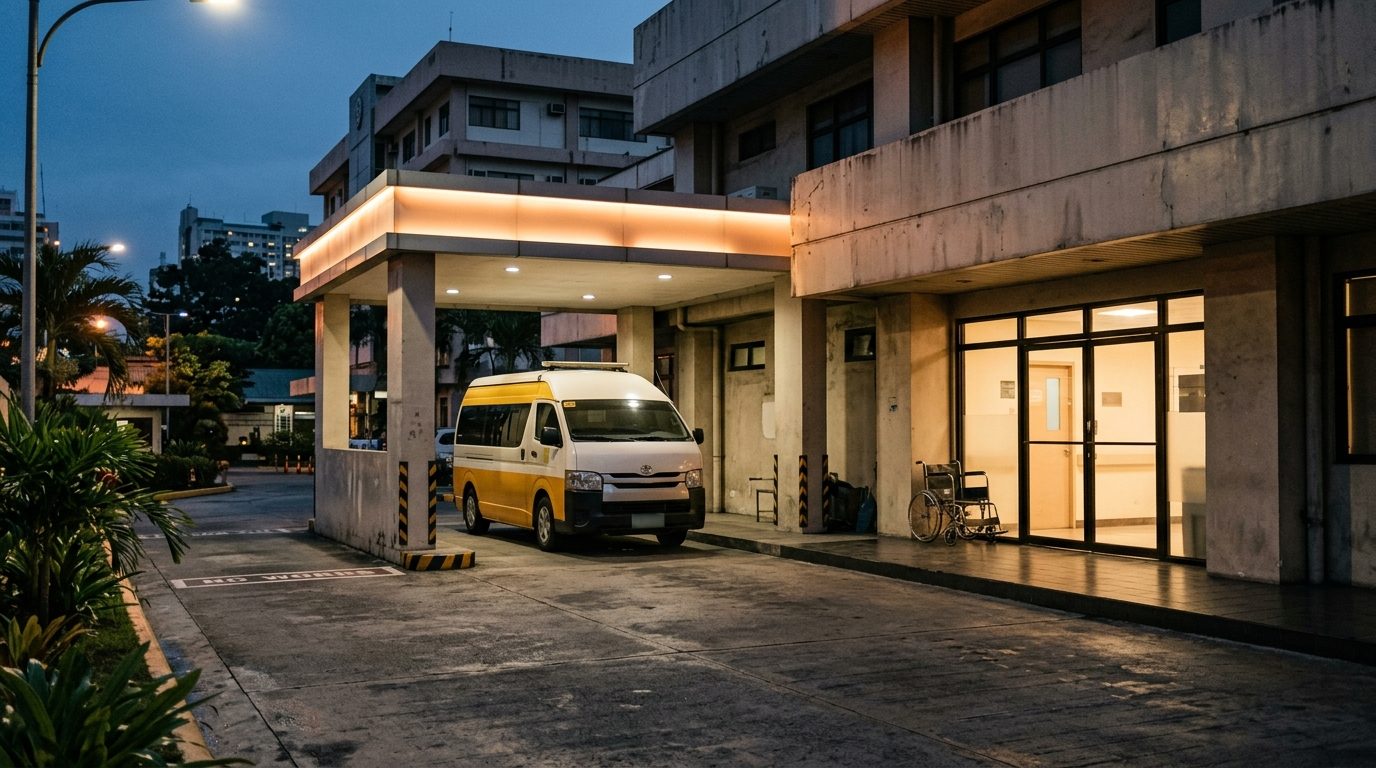
- Local government ambulances are dispatched through 911 or the city rescue office and are free to residents. RA 10932 also obliges the local government to lend its emergency vehicle when a hospital has no ambulance for an emergency transfer.
- Philippine Red Cross ambulances respond on 143; its ₱1,200-a-year Safe Card membership includes emergency ambulance service and a unit of blood (Philippine Red Cross).
- Hospital ambulances move patients between hospitals. At the Philippine General Hospital an ambulance conduction costs ₱1,230 to ₱2,070 depending on patient class, plus ₱130 to ₱150 a kilometre beyond 20 km (PGH rates and fees).
- Private ambulance companies such as Lifeline 16-911, which runs 65 DOH-licensed ambulances in Metro Manila and answers on 16-911 or (02) 8839-2525, sell memberships from ₱2,999 a year for an individual and ₱9,999 for a household, and charge per response otherwise.
What does the Anti-Hospital Deposit Law guarantee?
Republic Act 10932 (2017), which strengthened Batas Pambansa 702 and RA 8344, says that in an emergency or serious case no hospital or clinic officer, doctor or employee may request, demand or accept any deposit or advance payment as a condition for basic emergency care, confinement or treatment, or refuse treatment needed to prevent death, permanent disability, or injury to a pregnant woman or her unborn child. A hospital that lacks the capability may transfer the patient only after stabilising them, with consent, and only to a hospital that agrees; the receiving hospital may not refuse or demand a deposit. Penalties are six months to two years in prison or a fine of ₱100,000 to ₱300,000, or both; where the refusal was hospital policy, the responsible director faces four to six years or ₱500,000 to ₱1 million, and three such violations cost the hospital its licence. Complaints go to the Health Facilities Oversight Board of the DOH's Health Facilities and Services Regulatory Bureau. Every hospital must also post its DOH level and authorised services at the entrance; our guide to hospital levels explains what those mean.
What does PhilHealth pay in an emergency?
Three benefits apply. If you are admitted, PhilHealth's case rate for the diagnosis or procedure is deducted from the bill before discharge, and in a ward bed of one of the 87 DOH hospitals the balance is zero (Philstar explainer). If you are treated in the ER and sent home, the Outpatient Emergency Care Benefit created by PhilHealth Circular 2025-0020 covers ER services, tests and medicines for cases resolved within 24 hours; PhilHealth's Advisory 2026-0041 clarifies that once an admission order is issued the inpatient case rate applies instead. For catastrophic conditions the Z benefit packages pay fixed amounts at contracted hospitals, for example ₱500,000 for standard-risk childhood leukaemia and ₱1.4 million for breast cancer (PhilHealth benefits). Bring your PhilHealth number; a non-member can be enrolled at the hospital. Our guide to public and private hospitals explains what the balance looks like in each.
Which signs cannot wait?
Heart attack: chest pain that feels like crushing or squeezing, which may spread to the arm, neck or jaw; shortness of breath; nausea or vomiting; a burning, indigestion-like feeling; sweating; pale, blue or grey skin. Call for an ambulance rather than driving, sit and rest while waiting, and take 300 mg of aspirin if there is no allergy (NHS). Stroke: remember FAST, for Face drooping, Arm weakness, Speech difficulty and Time to call; other signs are one-sided weakness, loss of vision, confusion, dizziness, a sudden severe headache and vomiting. Symptoms that pass after a short time still need a hospital immediately (NHS). Poisoning: call the UP-PGH National Poison Management and Control Center on +63 2 8524 1078 before giving anything by mouth.
What should you bring, and how do you find the nearest ER?
Bring a government ID, the patient's PhilHealth number, current medicines or a list of them, any HMO card, and the phone number of a relative who can sign consent. Every Level 1 hospital and above runs an emergency room around the clock, so the nearest general hospital is the answer; for major trauma or a stroke the ambulance will head for a DOH regional medical center or a large private hospital with an ICU, such as Jose R. Reyes Memorial Medical Center in Manila, Vicente Sotto Memorial Medical Center in Cebu or Davao Regional Medical Center in Tagum. Save the number of the hospital nearest your home today, before you need it.
Frequently asked questions
- What is the emergency number in the Philippines?
- 911. The Department of the Interior and Local Government launched the Unified 911 system on 11 September 2025, replacing the separate hotlines of local governments, the police and the fire bureau with one number that routes calls to police, fire, medical or disaster response. Calls are free, the line runs 24 hours a day, and operators handle Tagalog, Cebuano, Ilocano, Waray, Tausug and other Philippine languages.
- How do I call an ambulance in the Philippines?
- Dial 911 for the local government or hospital ambulance nearest you, or the Philippine Red Cross on 143 (trunkline +63 2 8790 2300). Private services such as Lifeline 16-911, reachable on 16-911 or (02) 8839-2525, respond in Metro Manila and charge a fee or a yearly membership. Government hospitals also run ambulances for transfers; the Philippine General Hospital charges ₱1,230 to ₱2,070 a conduction plus a per-kilometre rate beyond 20 km.
- Can a hospital ask for a deposit in an emergency?
- No. Republic Act 10932, the Anti-Hospital Deposit Law as strengthened in 2017, makes it unlawful for any hospital or clinic, public or private, to demand a deposit or advance payment before giving basic emergency care, or to refuse treatment needed to prevent death or permanent disability. Violators face six months to two years in prison and fines of ₱100,000 to ₱300,000, rising to four to six years and ₱500,000 to ₱1 million where refusal is hospital policy.
- Which hospital should I go to in an emergency?
- The nearest one with an emergency room. Public hospital ERs must treat everyone, and a private hospital may not turn you away or demand a deposit. If the hospital cannot handle your case it must stabilise you first, then transfer you with your consent to a Level 2 or Level 3 hospital that can, and the receiving hospital may not refuse. For a stroke, heart attack or major injury the ambulance crew or 911 dispatcher will usually direct you to the nearest hospital with an ICU.
- Does PhilHealth cover emergency room treatment?
- Yes, in two ways. If you are admitted, the case rate for your illness or procedure is deducted from the bill, and in a ward bed of a DOH hospital the balance is zero. If you are treated in the ER and sent home within 24 hours, the Outpatient Emergency Care Benefit under PhilHealth Circular 2025-0020 pays for the ER services, tests and medicines used. Catastrophic conditions such as cancers and heart surgery fall under the Z benefit packages.
- What are the warning signs of a stroke?
- Use FAST: Face drooping on one side, Arm weakness or numbness, Speech that is slurred or confused, and Time to call for help immediately. Other signs are weakness down one side of the body, blurred vision or loss of sight, confusion, dizziness or falling, a sudden severe headache and vomiting. Even if the symptoms pass after a few minutes, get to a hospital straight away.
- Who do I call for poisoning?
- The National Poison Management and Control Center at UP-Philippine General Hospital, on +63 2 8524 1078, which gives advice around the clock on medicines, chemicals, plants and animal venoms. Take the container or a photo of the product with you to the emergency room.